Why Zinc Thickness and Process Determine Success or Failure?
In coastal industrial environments with high pollution and strong corrosive conditions, the operational reliability of power transmission lines faces severe challenges. For high-voltage tempered glass insulators, the corrosion resistance of their metal components (particularly the steel feet) directly determines the service life and safety factor of the entire line. In severely corrosive areas, improper selection of insulators may lead to mechanical strength degradation due to steel foot corrosion, potentially causing string drop incidents.
Core Basis for Corrosion Environment Selection: IEC TS 60815 Series Standards
When selecting insulators for heavily polluted and corrosive environments, the primary guideline is the IEC TS 60815 series standards issued by the International Electrotechnical Commission. The first step in the selection process involves assessing Site Pollution Severity (SPS). For ceramic and glass insulators, IEC TS 60815-2:2025 specifies detailed correction methods, including factors such as insulator shape, size, and creepage distance. Beyond electrical performance (creepage distance), the standard also implicitly requires high material weather resistance—particularly in chemically active corrosive areas, where the protective capability of metal accessories serves as the baseline for mechanical reliability.
3 Major Factors in Selection of Corrosion Protection Zones: Creepage Distance, Umbrella Type, and zinc sleeve pin of Glass insulator Protection
After determining the required creepage distance (e.g., for Class E or newly added Class F extremely polluted areas) based on IEC standards, we must also focus on three critical aspects for corrosive environments:
1. Sufficient and effective creepage distance
For heavily polluted and corrosive environments (e.g., chemical plants or coastal salt spray zones), P-type (anti-fouling) skirt skirts should be selected. Models like U160BLP or U120BLP or 120BP typically feature a creepage distance of 450mm to 550mm, with deep groove designs to suppress arcs and pollution flash overs.
2. The Advantage of "Zero-value Self-explosion" in Glass insulator
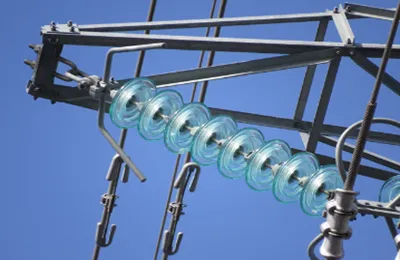
The tempered glass insulator has zero-value self-explosion characteristics. When internal defects exist or severe breakdown occurs, the umbrella disc will automatically burst, facilitating line patrol personnel to promptly identify fault points and preventing sudden accidents caused by further deterioration of concealed defects in corrosive environments.
3. The "Last Line of Defense" for Pin of glass insulator : Zinc sleeve Layer Protection
This is the most easily overlooked yet critical aspect in the selection of corrosion-resistant zones. The steel base is the core component subjected to mechanical loads. In humid, acid rain, or salt spray environments, the zinc coating acts as a sacrificial anode, serving as the sole barrier to protect the steel substrate from corrosion. Once the zinc layer is damaged or becomes too thin, the steel base will rapidly rust, leading to a sharp decline in mechanical strength.
To address the unique challenges of corrosion-prone areas, Nooa Electric's tempered glass insulators have set a new benchmark for corrosion resistance by leveraging 2 key technical features of steel feet.
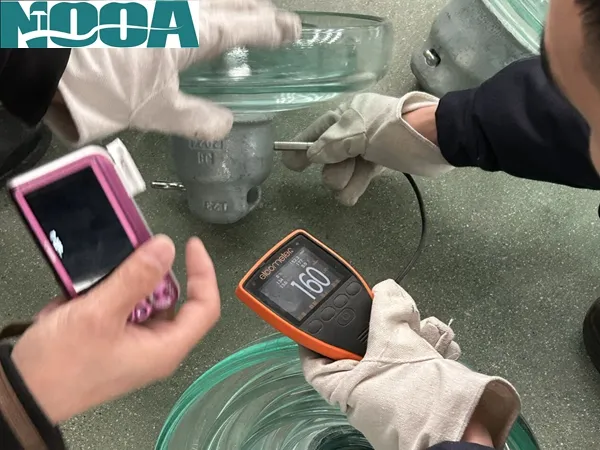
5mm ultra-thick zinc coating: far exceeding national standards for corrosion resistance redundancy
In conventional insulator designs, zinc coating thickness is often reduced to control costs. However, in highly corrosive environments, thicker zinc layers provide extended protection. Nooa Electric's insulator steel feet feature a 5mm zinc coating.
Technical Value: The 5mm zinc coating represents an ultra-high corrosion resistance configuration, far exceeding standard specifications. According to ISO or IEC standards, zinc thickness directly determines the rust resistance of steel feet in sulfide and chloride environments. This thick zinc layer not only provides extended protection but also effectively resists impact damage during transportation and installation.
Scenario suitability: For coastal substations or chemical plant perimeter lines, the 5mm zinc coating ensures the steel base remains protected from corrosive media throughout its decades-long service life.
Uniform Fusion Surface and "Non-Zinc Layer Shedding" Process: Addressing Industry Pain Points
Many insulators exhibit peeling and detachment of the zinc coating after 3-5 years of service. This is primarily attributed to uneven fusion between the steel base and the zinc layer, the presence of impurities, or insufficient bonding strength.
Nooa Electirc has achieved the following breakthroughs by optimizing the hot-dip galvanizing process:
The metallurgical combination: the dense iron-zinc alloy layer is formed between the zinc layer and the steel matrix, the fusion surface is uniform and there is no dead angle, the zinc layer is not empty and the zinc layer is not peeled off.
Zinc layer retention: Under strong gripping force and prolonged micro-vibration conditions, the uniform fusion surface ensures secure adhesion of the zinc layer. This process not only guarantees the integrity of corrosion protection but also eliminates potential hazards caused by detached zinc sheets to power grid operations.
Nooa Electirc series of corrosion resistant glass insulators
Based on above selection criteria, we recommend the following insulators solution for areas with severe corrosion:
Recommended models: U160BLP / U120BLP and 120BP anti-polluted tempered glass insulators.
Core corrosion protection configuration: Steel base with zinc coating thickness of 5mm (industry-leading level, ensuring long-term protection).
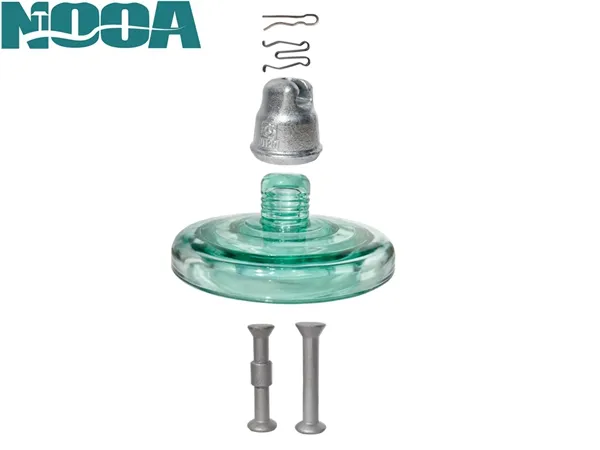
Connection structure: Complies with GB/T4056 and IEC60120 standards, featuring precise lock pin engagement. The R-type lock Cotter pin ensures anti-loosening performance.
Creepage distance: ≥550mm (meets flashover protection requirements for heavily polluted areas).