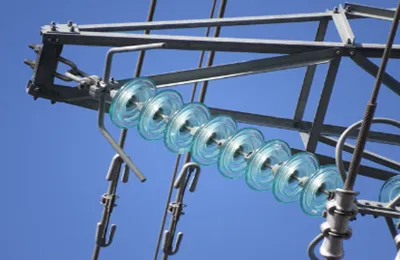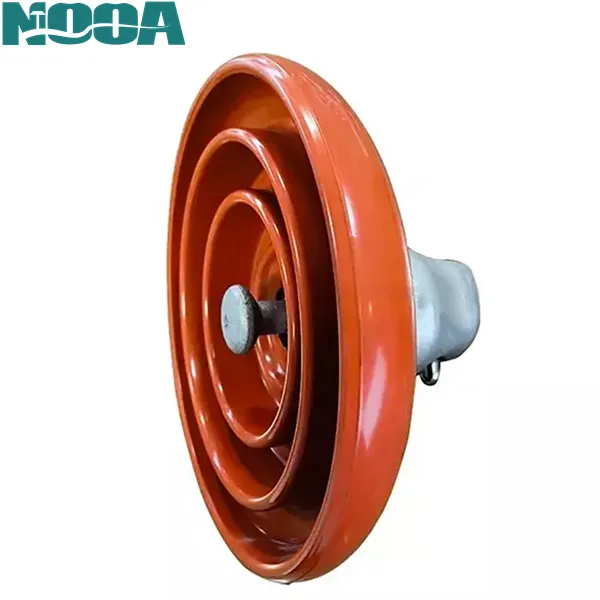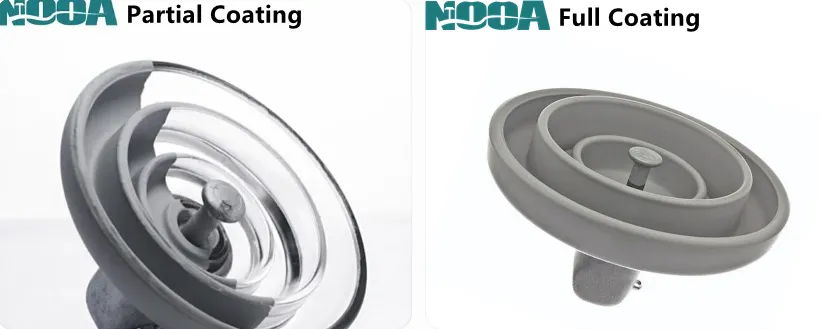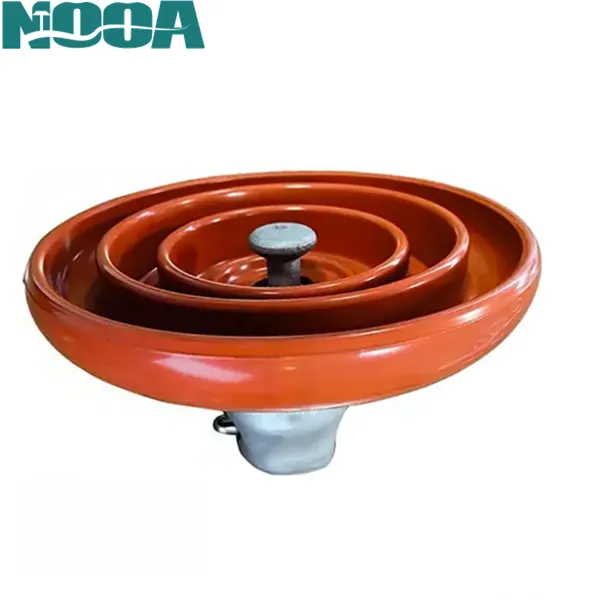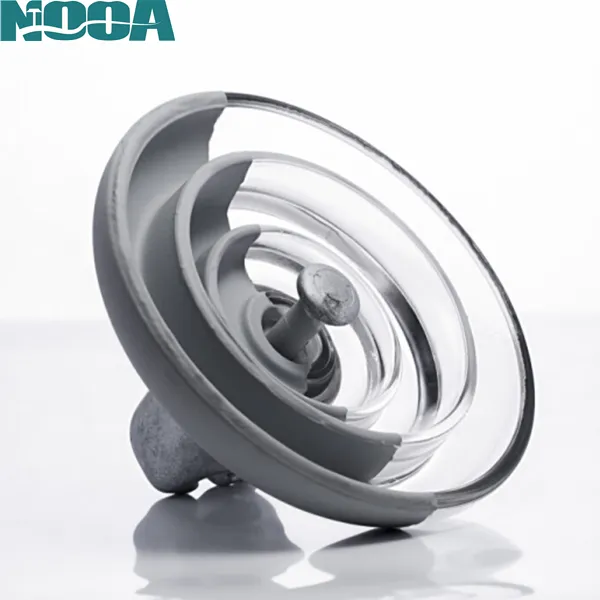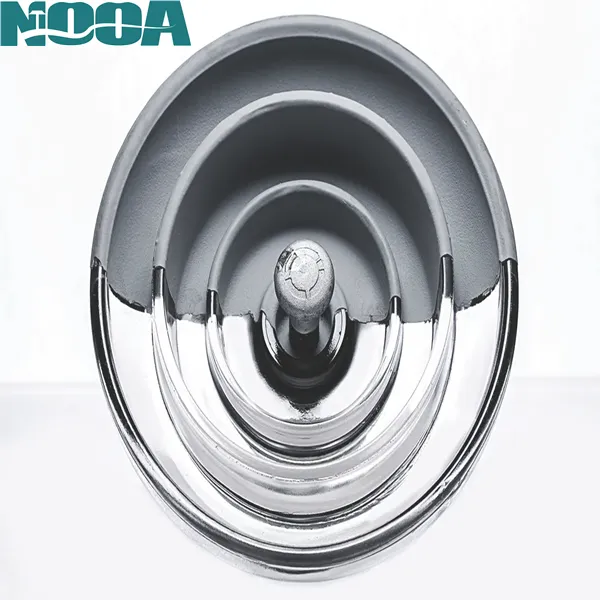
Pollution Resistance: The silicone layer repels water and prevents the formation of a continuous conductive moisture film, drastically reducing leakage current.
Flashover Prevention: By suppressing leakage currents, it prevents pollution flashovers in heavy industrial, coastal, or desert environments with high airborne contamination.
Self-Cleaning Properties: Rain easily washes away dust and grime from the hydrophobic silicone surface.
Retains Glass Integrity: Utilities keep the puncture-proof, stable core characteristics of toughened glass while gaining the anti-pollution performance of composite/silicone designs.
Parameter
Value

Standard
IEC 60383
Mechanical failing load
120 kN
Brand
Nooa Electric
Leading time
1 month
High-voltage and extra-high-voltage overhead power transmission and distribution lines.
Substations and power grids located in areas with severe salt-fog, industrial smoke, or desert dust.
The main difference between fully coated RTV glass insulators and partially coated RTV glass insulators is the coverage area of the RTV silicone rubber coating. This affects pollution flashover protection, coating material consumption, manufacturing costs, and maintenance requirements. RTV stands for Room Temperature Vulcanizing, referring to silicone rubber coatings that cure at room temperature.
|
Comparison |
Full Coating |
Partial Coating |
|
Coating coverage |
Entire specified glass surface |
Designated surface areas |
|
RTV material consumption |
Higher |
Lower |
|
Coating cost |
Relatively higher |
Relatively lower |
|
Hydrophobic protection |
More comprehensive surface coverage |
Limited to coated areas |
|
Pollution flashover protection |
Wider protection coverage |
Depends on the coating design |
|
Typical applications |
Heavily and extremely polluted environments |
Projects requiring targeted pollution protection |
Q1. What is a 120 kN Siliconized Glass Suspension Insulator?
A 120 kN Siliconized Glass Suspension Insulator is a toughened glass disc insulator with a silicone-based surface treatment, designed for overhead transmission lines with a rated mechanical failing load of 120 kN.
Q2. What is the purpose of siliconizing a glass insulator?
Siliconizing improves surface hydrophobicity, helping reduce water film formation and leakage current under wet and polluted operating conditions.
Q3. What is the difference between siliconized and standard glass insulators?
Standard glass insulators have an untreated glass surface, while siliconized glass insulators feature an additional silicone-based coating to improve surface hydrophobicity and pollution performance.
Q4. What is the rated mechanical failing load of this insulator?
The rated mechanical failing load is 120 kN, which determines its specified mechanical load-bearing capacity.
Q5. Which international standards apply to siliconized glass suspension insulators?
The glass disc insulator design and electrical and mechanical testing can reference IEC 60383.
Q6. How does the silicone coating improve pollution performance?
The silicone coating provides hydrophobic properties that help limit continuous water films and reduce leakage current on contaminated insulator surfaces.
Q7. How are siliconized glass suspension insulators tested?
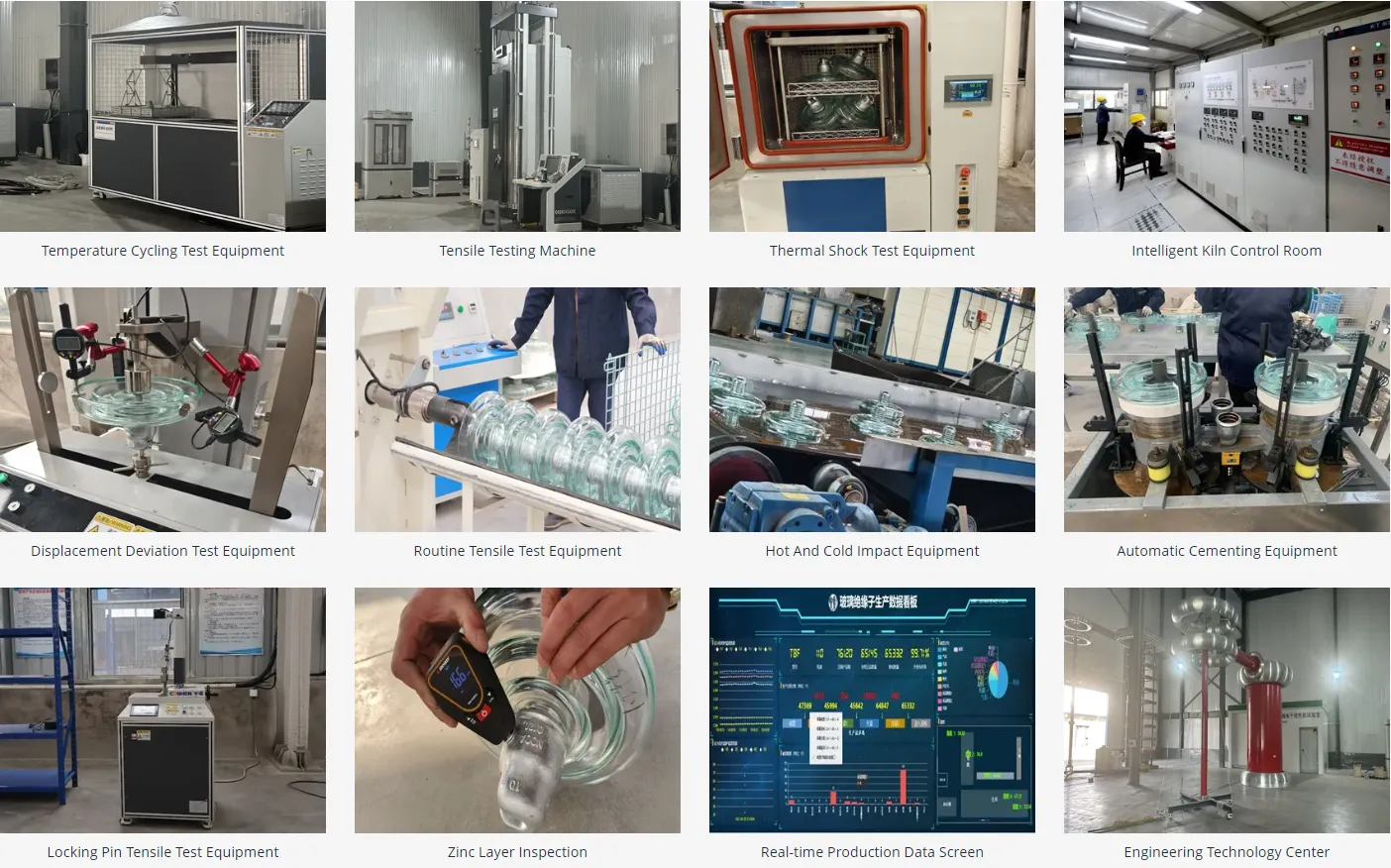
Testing can include visual inspection, dimensional verification, mechanical failing load testing, electrical performance testing, and coating-related hydrophobicity and adhesion assessments.
Who We Are?
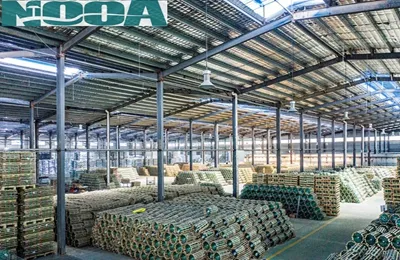
Nooa Electric Co., Ltd. - Chinese professional electrical glass insulators manufacturer with 21+ experience, covering an area of 70,000 square meters, and construction area is 50,000 square meters. There are more than 200 employees, including 25 technicians. The production capacity 3500000 pieces per year, and now setting up the new kiln and lines up to 10500000 pieces per year. We have been specialized in research and development of latest high-strength functional glass and power transmission insulators, which is the qualified supplier for State Grid Corporation of China and Southern State Grid Corporation of China, and is a participating unit of product standard formulation of the national electrical insulator standard committee.
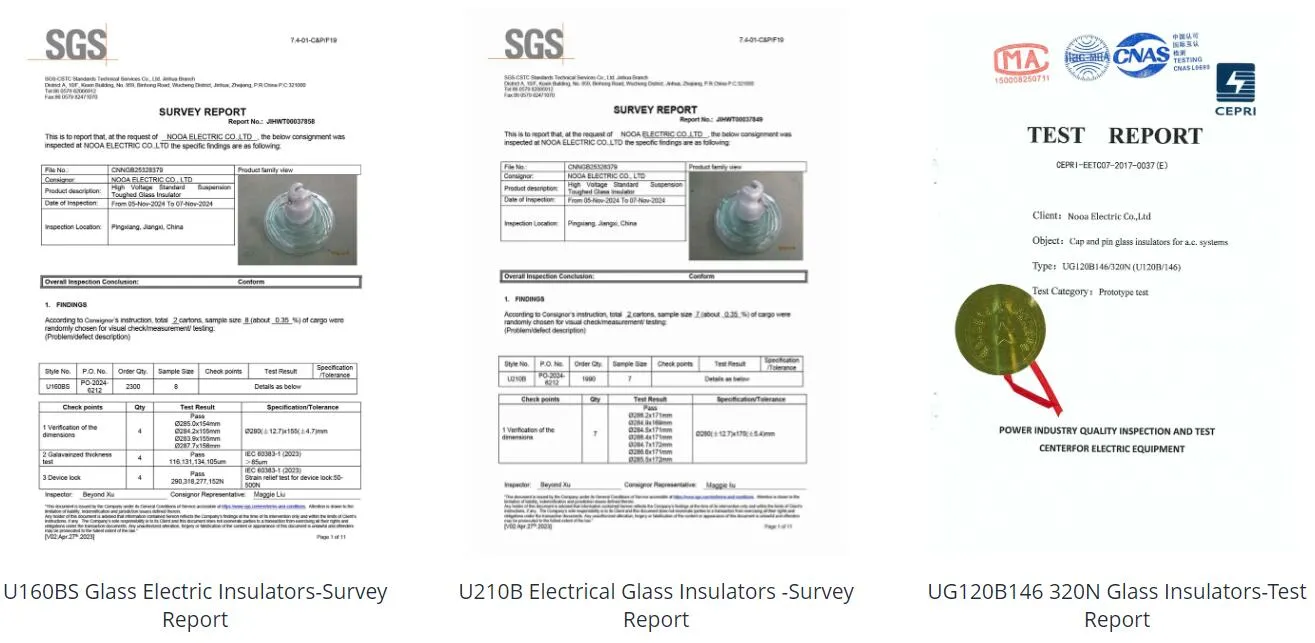
Certificates & Reports: INTERTK, SGS, BV Certificates,Type Test Certificate.
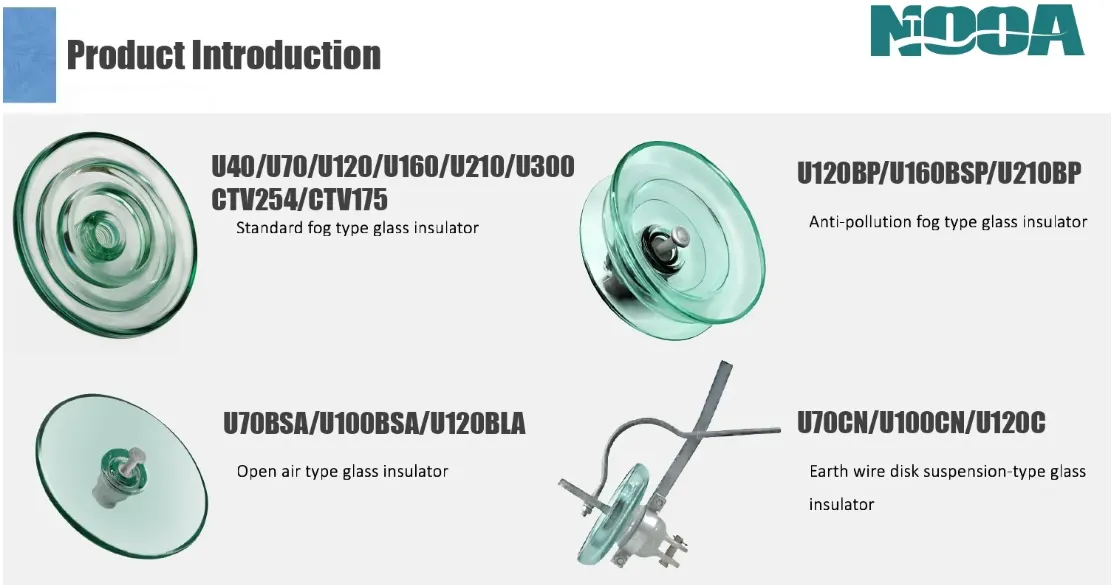
Main Electric Insulators : Standard-type glass insulator (u40(ctv175)/u70(ctv254, ps70e)/u120/u160/u210/u300) , antipollution-type glass insulators (u120bp/u160bsp/u210bp), aerodynamic type glass electrical insulators (ug70bsa/u100bsa/u120bla), multi-umbrella type electric insulators, ground-wires type glass power line insulators (u70cn/u100cn/u120c), post insulator for line, pin glass insulator. Products are mainly used for transmission line insulation, suspension, support, tension conductors. They are divided into 5 major series: The standard type glass insulator 40-550kn, filth-resistant type glass insulators 70-420kn, aerodynamic type glass electrical insulators 120-300kn, multi-umbrella type electric insulators 120-300kn, and ground circuit type high voltage insulators, able to be used for line voltage from 10kv~1000kv.
Core Technology:
Automation Equipment: Siemens fully automatic feeding, stamping, temperature equalization, tempering, hot and cold shock control system.
Independent Product Model: U160BP/146/380/450, U160BP/155/380/450, U210BP/170/420/550 and U300BP/195/420/550.
Advanced Klin: Germany's new generation kiln control system, equipped with brand-new sensors and actuators, and equipped with a high-precision automatic batching system.
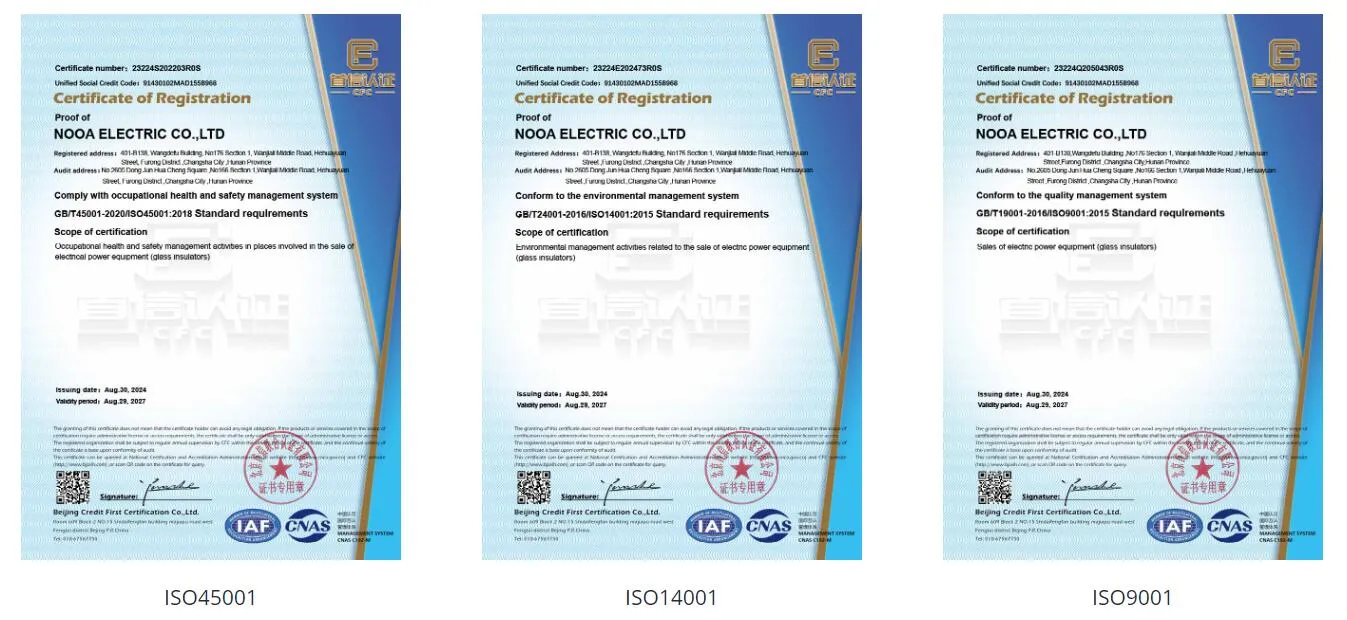
Qualification: Passed the quality, environment and occupational health system certification and obtained a number of invention patents.
Goal:
To be the world's largest glass insulators manufacturer.