Glass Insulator V-String: Structure, Advantages & Applications in High-Voltage Transmission
Glass insulator V-strings are widely used in high-voltage and extra-high-voltage transmission lines to increase mechanical stability, reduce conductor swing, and enhance line reliability during heavy wind, ice, and storm conditions. By connecting two toughened glass insulator strings in a V-shaped configuration, utilities achieve greater load distribution, minimized galloping, and improved insulation performance.
What Is a Glass Insulator V-String?
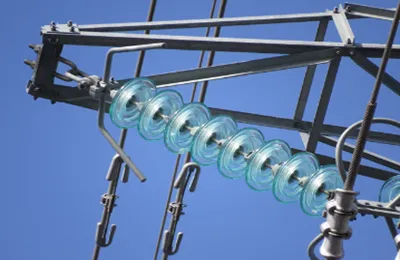
A V-string consists of two glass disc insulator strings arranged in a V shape to support high mechanical loads and minimize conductor swing.
A glass insulator V-string, sometimes called a V-suspension string, V-type insulator assembly, or V-shaped tension string, is formed by connecting two toughened glass insulator chains between the tower cross-arm and the transmission line conductor. The angle between the two strings typically ranges from 30° to 60°, depending on mechanical design requirements.
V-strings are commonly used in:
Long-span transmission lines
High-wind or heavy-storm areas
Line angle positions requiring enhanced stability
High-voltage (HV), extra-high-voltage (EHV), and UHV systems
Manufacturers like Nooa Electric provide complete V-string assemblies compliant with IEC, ANSI, and regional utility standards.
Why Use V-String Configurations?
Quick Summary: V-strings reduce swing, distribute load, and improve safety under extreme mechanical stress.
Key technical benefits include:
✔ Reduced Conductor Swing & Galloping
The dual-string structure stabilizes the conductor, lowering the risk of flashover and mechanical damage.
✔ Higher Mechanical Strength
Loads are shared between two strings, making V-configurations ideal for long spans, heavy ice loading, and steep line angles.
✔ Improved Safety Margin
V-strings maintain stable geometry even during extreme weather, ensuring reliability for 110kV, 220kV, 400kV, and 500kV networks.
✔ Enhanced Vibration Control
Better damping reduces risk of fatigue fracture in fittings and conductors.
✔ Space Optimization on Towers
V-strings can replace double I-strings while providing similar or greater stability.
Structure and Components of a Glass Insulator V-String
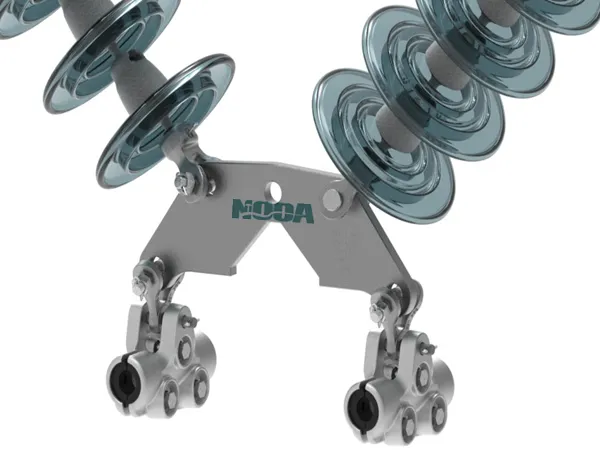
V-strings consist of two parallel glass insulator chains plus hardware like yoke plates, ball-and-socket fittings, and clevis accessories.
A typical Nooa Electric glass V-string assembly includes:
Two toughened glass disc insulator strings (U70B, U120B, U160B, U210B, etc.)
Yoke plates / V-yoke plates that connect the two legs
Ball-and-socket or clevis fittings
Corona rings for EHV/UHV applications
Armor rods or suspension clamps to protect the conductor
Hardware fittings compliant with IEC 61284 and IEC 60120
These components ensure optimal electrical and mechanical performance for long-term field operation.
Applications of Glass Insulator V-Strings
Used in long-span, windy regions, high-angle towers, and EHV–UHV transmission projects.
V-strings are used in:
High-voltage suspension towers requiring extra support
Mountain or desert transmission lines exposed to strong winds
Long spans exceeding 300–500 meters
132kV, 220kV, 330kV, 400kV, 500kV transmission systems
Line angle towers where standard I-strings are insufficient
Areas with high icing or conductor galloping risk
Utilities select V-strings to increase line stability and minimize maintenance over the insulators’ lifetime.
Advantages of Toughened Glass V-Strings Over Other Materials
They offer superior visibility, aging resistance, and predictable failure patterns.
✔ Zero Aging and Long Service Life
Toughened glass maintains dielectric and mechanical performance for decades.
✔ Easy Visual Inspection
Any damage is instantly visible due to the self-shattering nature of glass discs.
✔ High Electrical Reliability
Low dielectric loss and consistent surface performance support stable insulation even under polluted conditions.
✔ Predictable Mechanical Behavior
Glass discs fail safely without causing catastrophic string failure—ideal for V-shaped load distribution.
✔ Cost-Effective Over Time
With low maintenance requirements, V-strings offer long-term savings for utilities.
Why Choose Nooa Electric for Glass Insulator V-Strings?
Nooa Electric provides fully tested, IEC-compliant V-string systems tailored to customer specifications.
Nooa Electric offers:
Toughened glass discs manufactured with high-purity raw materials
100% mechanical and electrical routine testing
Full sets of V-string hardware: yoke plates, clamps, arcing horns, corona rings
Custom V-angle design based on span length and conductor load
Models suitable for 70kN, 120kN, 160kN, 210kN, 300kN load classes
Decades of experience supplying utilities across Europe, Asia, Africa, and South America
Their engineering team supports customers with drawings, strength calculations, and optimized V-string configurations for HV and EHV projects.
FAQ: Glass Insulator V-Strings
1. What determines the angle of the V-string?
The V-angle is based on mechanical load, span length, and tower design. Common angles: 30°–60°.
2. How many glass discs are used in each leg of the V-string?
It depends on voltage level:
110kV: 6–9 discs per leg
220kV: 12–15 discs
400kV: 18–23 discs
500kV: 22–28 discs
3. Can V-strings be used as tension strings?
Yes. V-strings are often used at angle towers or dead-end positions requiring higher mechanical strength.
4. Are V-strings better than double I-strings?
V-strings provide better stability, less swing, and higher load distribution—ideal for windy or long-span lines.
5. What type of glass discs are commonly used?
Standard toughened glass discs such as U70B, U120B, U160B, U210B, U300B, including fog-type or open-profile designs.