1.Common Bubble Defects in Glass Insulator Shell
Bubble defects occur when gas becomes trapped inside molten glass and cannot escape before solidification.
Bubble defects are among the most frequently observed imperfections in glass insulators. They appear as visible cavities or air pockets inside the glass body.
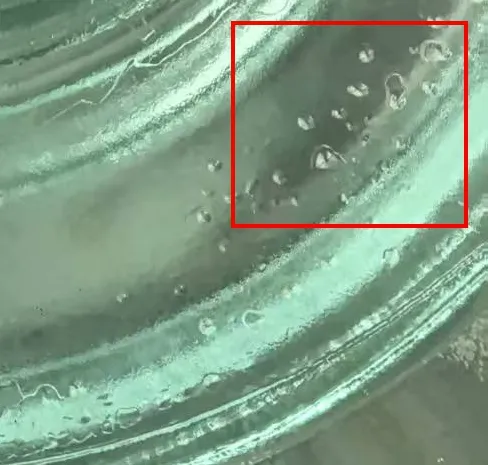
Main causes:
Moisture in raw materials
Incomplete melting
Insufficient refining process
Excessive glass viscosity
Air introduced during feeding or forming
Potential impacts:
Localized stress concentration
Reduced mechanical strength
Lower impact resistance
Increased risk of spontaneous failure
Types of bubble defects include:
Micro bubbles (<0.5 mm)
Large bubbles (>2 mm)
Surface blisters
Bubble chains
Internal gas inclusions
For high-voltage suspension glass insulators, excessive bubble defects may significantly reduce reliability under mechanical loading.
2.Cold Lines and Striae Defects
Cold lines form when molten glass with different temperatures or viscosities does not mix uniformly.
Cold lines, also known as cold streaks or striae, appear as lines or wave-like patterns inside the glass structure.
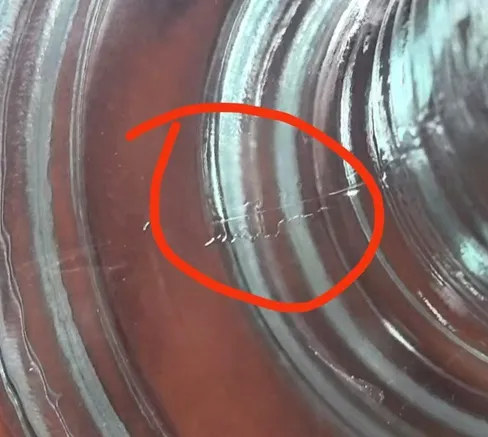
Main causes:
Uneven furnace temperature
Poor glass homogenization
Inadequate mixing
Unstable feeding systems
Improper mold temperature
Potential impacts:
Internal stress concentration
Optical irregularities
Reduced structural consistency
Higher possibility of breakage
Cold lines often become more critical after the tempering process because stress distribution inside toughened glass becomes highly sensitive to material inconsistencies.
3.Stone and Unmelted Particle Defects
Stone defects are hard, unmelted foreign particles trapped inside the glass.
Stone defects can originate from:
Unmelted silica particles
Refractory material erosion
Furnace contamination
Improper batch mixing
Typical characteristics include:
Hard inclusions inside glass
Irregular shapes
Different refractive appearance
Potential impacts:
Mechanical weakness points
Internal stress concentration
Surface cracking initiation
Reduced electrical reliability
Stone defects are considered severe quality issues in transmission-grade glass insulators.
4.Crack Defects in Glass Insulators
Cracks are fractures caused by mechanical, thermal, or manufacturing stresses.
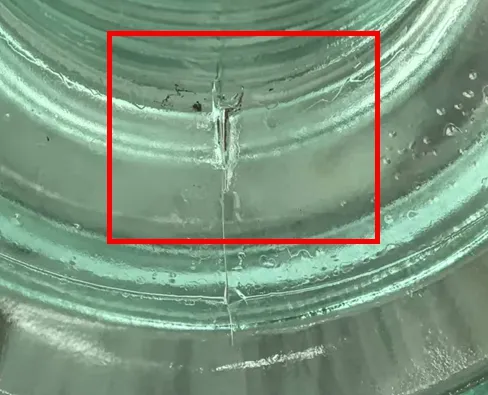
Cracks can occur during:
Production:
Improper cooling
Excessive residual stress
Mold release problems
Transportation:
Collision damage
Poor packaging
Installation:
Improper handling
Excessive mechanical loading
Types include:
Surface cracks
Internal cracks
Hairline cracks
Edge cracks
Potential impacts:
Immediate strength reduction
Moisture penetration
Accelerated failure risk
Lower service life
Even small cracks may eventually propagate under long-term cyclic loading.
5.Stress Distribution Defects
Improper tempering can create uneven residual stress within the glass shell.
Tempered glass insulators rely heavily on balanced compressive and tensile stress layers.
Common reasons include:
Uneven cooling rate
Tempering furnace variation
Process parameter instability
Symptoms may include:
Abnormal stress patterns under polarized light
Distortion
Increased self-breakage probability
Stress imbalance directly affects:
Mechanical breaking load
Thermal shock resistance
Long-term operational stability
6.Surface Defects and Appearance Imperfections
Surface defects affect both aesthetics and operational performance.
Common surface flaws include:
Scratches
May occur during handling or transportation.
Mold marks
Produced by mold wear or contamination.
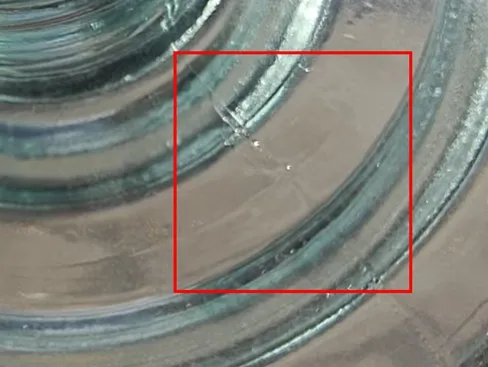
Surface pits
Caused by trapped impurities.
Ripple patterns
Generated by unstable glass flow.
Surface contamination
Produced by foreign particles or dust.
Potential effects include:
Reduced flashover resistance
Increased contamination accumulation
Lower hydrophobic behavior
Accelerated aging
7.Edge and Dimensional Defects
Dimensional deviations can negatively influence fitting compatibility and load distribution.
Examples include:
Uneven thickness
Warped profiles
Misalignment
Edge irregularities
Diameter deviations
Possible consequences:
Assembly difficulties
Uneven stress loading
Reduced installation accuracy
8.Quality Inspection Methods for Glass Insulator Defects
Multiple inspection techniques are used to identify defects before shipment.
Common inspection methods include:
1.Visual inspection
Detects surface flaws and visible defects.
2.Polarized stress inspection
Evaluates internal stress distribution.
3.Optical transmission testing
Identifies bubbles and inclusions.
4.Mechanical load testing
Verifies structural strength.
5.Thermal shock testing
Measures temperature resistance.
6.Electrical performance testing
Checks insulation capability.
For utility-grade transmission insulators, strict quality control significantly reduces operational failures.
9.FAQ About Common Glass Insulator Shell Flaws
1. What is the most common defect found in glass insulators?
Bubble defects are among the most commonly observed defects because trapped gas can remain inside the molten glass during manufacturing.
2. Do bubbles always affect glass insulator performance?
Small bubbles may only affect appearance, but larger or concentrated bubbles can weaken mechanical strength.
3. Why do cold lines appear in glass insulators?
Cold lines result from uneven temperature distribution and insufficient mixing of molten glass.
4. Can cracked glass insulators still be used?
Cracked insulators should generally not be used because cracks can propagate and lead to failure.
5. What causes stone defects in glass insulators?
Stone defects are usually caused by unmelted raw materials or refractory contamination.
6. How are internal defects detected?
Manufacturers commonly use optical inspection systems and polarized light stress testing.
7. Can stress defects cause spontaneous breakage?
Yes. Uneven residual stress can increase the likelihood of spontaneous breakage.
8. Are surface scratches dangerous?
Minor scratches may have limited impact, but deep scratches can become stress concentration points.
9. Which defect has the greatest impact on mechanical strength?
Cracks and severe internal inclusions generally have the greatest influence on strength reduction.
10. How can manufacturers like Nooa Electric reduce defect rates?
By controlling raw material quality, optimizing melting temperatures, improving tempering processes, and applying strict inspection procedures.