How RTV Coating Affects Creepage Distance and Leakage Current in High-Voltage Insulators
RTV (Room Temperature Vulcanized) silicone coating is widely applied to high-voltage insulators to enhance anti-pollution performance and improve long-term electrical reliability. While RTV coating does not physically increase the geometric creepage distance, it significantly alters surface electrical behavior by maintaining hydrophobicity, reducing leakage current, and effectively improving the electrical creepage performance of insulators under polluted and wet conditions. Here Now, We Nooa Electric will provide a comprehensive analysis of how RTV coating affects creepage distance and leakage current, including working mechanisms, performance benefits, limitations, and practical applications.
Understanding Creepage Distance in High-Voltage Insulators
Creepage distance is the shortest path along the insulator surface between energized and grounded parts.
Creepage distance is a critical insulation parameter in overhead lines and substations, especially in polluted environments. It determines the insulator’s resistance to surface flashover when contaminants and moisture are present.
Key influencing factors include:
-
Insulator profile and shed design
-
Pollution severity level
-
Surface condition and wettability
-
Environmental humidity and salt deposition
Longer creepage distance generally improves pollution withstand capability, but increasing creepage alone is not always economical or structurally feasible.
What Is Leakage Current and Why It Matters
Leakage current is the small current flowing along an insulator surface under operating voltage.
Leakage current increases when:
-
Surface contamination dissolves in moisture
-
Continuous water films form
-
Conductive paths develop across the insulator surface
High leakage current leads to:
Controlling leakage current is therefore essential for maintaining safe and stable transmission line operation.
Does RTV Coating Increase Creepage Distance?
RTV coating does not change geometric creepage distance but improves effective creepage performance.
RTV silicone coating adds only a thin layer (typically 0.3–0.5 mm) to the insulator surface and does not increase the physical creepage length defined by standards such as IEC 60815.
However, RTV coating:
-
Prevents formation of continuous conductive water films
-
Maintains droplet-shaped moisture distribution
-
Interrupts leakage current paths
As a result, the effective creepage distance is functionally improved, allowing existing insulators to perform like units with longer creepage in polluted environments.
How RTV Coating Reduces Leakage Current
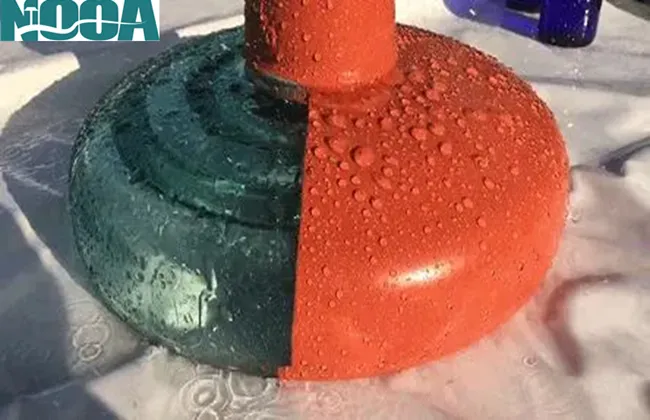
RTV coating minimizes leakage current by maintaining long-term hydrophobicity.
The primary mechanism is surface hydrophobicity:
-
Water beads instead of spreading
-
Contaminants remain non-conductive
-
Surface resistance remains high
RTV silicone coatings also exhibit hydrophobicity transfer, where low-molecular-weight silicone migrates to the surface, restoring water repellency even after temporary degradation.
Products supplied by Nooa Electric are formulated to ensure stable hydrophobic behavior under severe pollution and high humidity.
Impact of RTV Coating Under Pollution Conditions
RTV coating is most effective in heavily polluted and coastal environments.
Under conditions such as:
Uncoated insulators quickly develop high leakage current. RTV-coated insulators, however:
This makes RTV coating a proven anti-pollution solution for substations and transmission lines.
RTV Coating vs. Increasing Creepage Distance
RTV coating is a cost-effective alternative to increasing creepage distance.
Comparison highlights:
-
Increasing creepage requires larger or special-profile insulators
-
RTV coating allows existing insulators to be upgraded
-
No structural changes to towers or hardware
-
Short application time and minimal outage
Many utilities use RTV coating in combination with standard creepage insulators to meet severe pollution requirements without redesigning the line.
Long-Term Performance and Aging Considerations
High-quality RTV coatings provide stable performance for 8–15 years.
Over time, RTV coatings may experience:
-
UV exposure
-
Surface erosion
-
Pollution accumulation
Nevertheless, premium RTV materials—such as those applied by Nooa Electric—maintain acceptable hydrophobicity and low leakage current throughout their service life, with significantly reduced maintenance compared to frequent washing.
Practical Engineering Implications
RTV coating improves insulation reliability without altering mechanical or dimensional design.
From an engineering perspective:
-
Creepage distance remains unchanged in drawings
-
Electrical performance is enhanced in real operation
-
Leakage current monitoring shows measurable reduction
-
Line availability and reliability are improved
RTV coating is therefore an effective retrofit and preventive maintenance measure.
FAQ: RTV Coating, Creepage Distance, and Leakage Current
Q1: Does RTV coating count as creepage distance in IEC standards?
A: No. RTV coating does not increase the standardized geometric creepage distance.
Q2: Why does an RTV-coated insulator perform like one with longer creepage?
A: Because hydrophobicity breaks leakage current paths and reduces surface conductivity.
Q3: Can RTV coating completely eliminate leakage current?
A: No, but it significantly reduces leakage current to safe levels.
Q4: Is RTV coating suitable for glass, porcelain, and composite insulators?
A: Yes, it is commonly applied to all three types.
Q5: How often should RTV coating be reapplied?
A: Typically after 8–15 years, depending on environment and coating quality.