1. Why Is Curing Necessary for Glass Insulators?
1.1 Promote Cement Hydration and Improve Bonding Strength
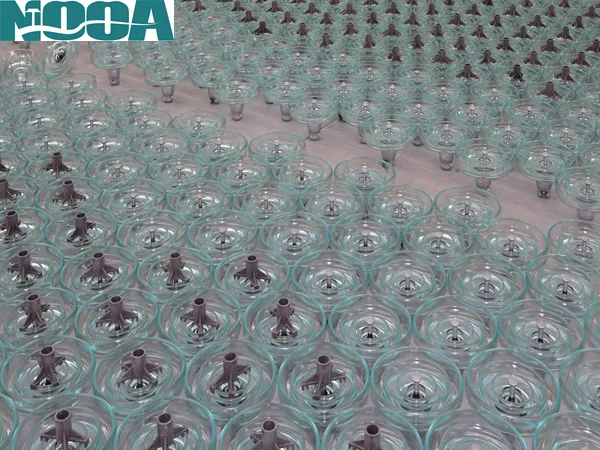
Because after the cementing and water-spraying processes, glass disc insulators must undergo a proper curing period before proceeding to subsequent quality inspections and testing. The purpose of curing is to maintain suitable moisture and temperature conditions, allowing the cement to continue hydrating and gradually develop the required bonding strength.
In glass disc insulators, cement is used to bond the steel cap and steel pin to the glass shell, forming a secure mechanical connection. During the hardening process, cement requires sufficient moisture to complete its hydration reaction. If moisture is insufficient, hydration may be incomplete, preventing the cement from achieving its expected strength.
1.2 Prevent Rapid Moisture Loss and Reduce Cracking
If newly cemented insulators are exposed directly to high temperatures, dry air, or strong airflow, moisture may evaporate too quickly from the cement. This may lead to:
Incomplete cement hydration.
Increased cement shrinkage.
Microcracks in the cement layer.
Reduced bonding quality between the cement and the metal or glass components.
The purpose of curing: To prevent premature moisture loss and reduce the risk of early-age shrinkage cracking.
1.3 Improve the Mechanical Stability of the Cemented Assembly
During operation, glass insulators must withstand mechanical loads caused by conductor tension, wind pressure, ice loading, and other environmental conditions. The bonding quality between the steel cap, steel pin, and glass shell directly affects the mechanical load-bearing capacity of the entire insulator. The purpose of curing is to allow the cement to harden sufficiently and form a stable bonding structure, providing a reliable foundation for subsequent mechanical load testing.
1.4 Ensure Reliable Results in Subsequent Quality Testing
After the curing process, glass insulators undergo relevant quality inspections and tests, which may include:
Visual inspection.
Dimensional inspection.
Mechanical failing load test.
Locking device inspection.
Other inspections and tests required by applicable standards. If the curing period is insufficient, the cement may not have developed the required strength, potentially affecting mechanical test results or causing premature failure.
2. Why Is Water Spraying Necessary After Cementing?
Water spraying is primarily intended to provide the cement with sufficient moisture and prevent excessive water loss during the early hardening stage. It helps maintain the moisture conditions necessary for cement hydration and it is important to distinguish between 2 processes:
Process
|
Main Purpose
|
Water Spraying
|
Supply moisture and keep the cemented areas sufficiently moist
|
Curing
|
Maintain appropriate temperature, humidity, and time conditions to allow cement hydration and strength development
|
Water spraying does not mean that the curing process is complete. It is one of the moisture-management measures used during curing. The insulators must still undergo the required curing period according to the established production process (72 Hours)
Curing Is an Essential Step in Glass Insulator Manufacturing
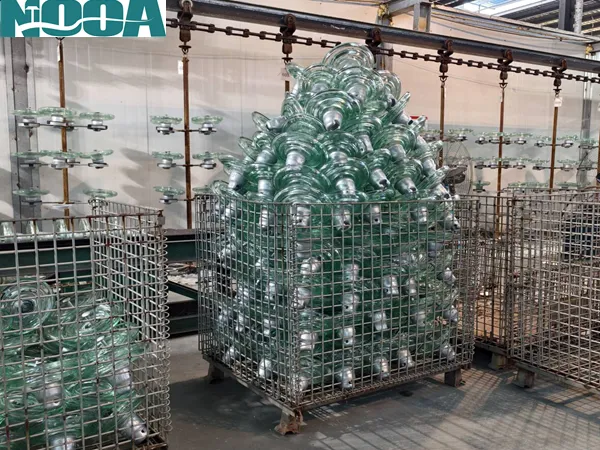
Curing after cementing is essentially the process of cement hydration and strength development.
The typical production sequence is:
Cementing → Water Spraying → Curing → Subsequent Inspection & Testing → Finished Product Storage
Insufficient curing may result in inadequate cement strength, early-age cracking, and reduced mechanical reliability of the cemented assembly. Therefore, proper curing conditions are an essential part of quality control in glass insulator manufacturing.
As glass insulator manufacturer - we Nooa Electric keep that curing is not simply a waiting period. It is a critical production process that helps ensure consistent cementing quality and reliable mechanical performance.
Frequently Asked Questions
1. What is curing in glass insulator manufacturing?
Curing is the process of maintaining suitable temperature and moisture conditions after cementing to allow the cement to undergo hydration and gradually develop the required bonding strength between the glass shell, steel cap, and steel pin.
2. Why do glass insulators need curing after cementing?
Curing helps ensure sufficient cement hydration, prevent premature moisture loss, reduce the risk of early-age cracking, and improve the mechanical stability of the cemented assembly.
3. What is the difference between water spraying and curing?
Water spraying is a moisture-supply process that helps prevent the cement from drying too quickly. Curing is a broader process that involves controlling moisture, temperature, and time to support proper cement hydration and strength development.
4. How long should glass insulators be cured after cementing?
72 hours normally(but the curing period depends on the cement formulation, water-cement ratio, ambient temperature, humidity, and manufacturing process for different seasons)
5. What happens if glass insulators are not cured properly?
Insufficient curing may result in incomplete cement hydration, inadequate bonding strength, early-age cracking, and reduced mechanical reliability. In severe cases, it may affect the results of subsequent mechanical failing load tests.
6. Does curing affect the mechanical strength of glass disc insulators?
Yes. Proper curing allows the cement to develop the required strength and form a stable connection between the glass shell and metal fittings. This is important for ensuring that the assembled insulator can withstand its specified mechanical loads.
7. Is curing necessary for all types of glass disc insulators?
Yes. Glass disc insulators with cemented metal fittings require appropriate curing to ensure cement hydration and bonding quality. However, specific curing conditions and durations may vary depending on the insulator design, cement formulation, and manufacturing process.