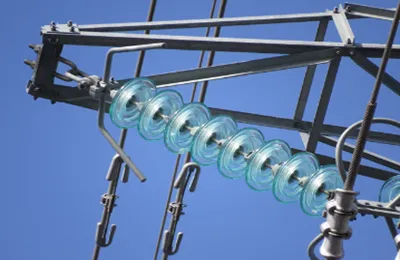
Steep Wave Test vs. Lightning Impulse Test for Glass Insulators: What Should Buyers Know?
For buyers of high-voltage glass insulators, the steep wave test and lightning impulse test are not interchangeable electrical tests. Although both apply impulse voltages to simulate severe transient conditions, they stress a glass insulator in different ways and provide different information about its electrical performance and manufacturing quality.
The lightning impulse test primarily evaluates the external insulation performance and flashover withstand capability of the insulator, while the steep-front impulse test can be much more sensitive to internal defects and the risk of puncture in ceramic or glass insulator units.
For international tenders and EPC projects, therefore, the right question is not simply whether a supplier has performed an impulse test, but which impulse test was performed, according to which standard, at what voltage and wave shape, and what the acceptance criterion was.
For ceramic and glass overhead-line insulators above 1,000 V, IEC 60383-1:2023 is an important reference standard covering definitions, test methods and acceptance criteria. The current edition specifically includes an impulse puncture test in air among its technical changes. IEC 61211:2004 is also specifically dedicated to impulse puncture testing in air for Class B ceramic and glass insulator units.
1. What Is the Difference Between a Steep Wave Test and a Lightning Impulse Test?
A lightning impulse test uses a standardized lightning-type impulse to evaluate insulation performance under a simulated lightning surge, while a steep-front impulse test uses a much faster voltage rise to impose a more severe electrical stress that can reveal weaknesses associated with puncture and internal construction.
A lightning impulse test, often called a lightning impulse withstand test or standard lightning impulse test, uses a standardized impulse waveform commonly expressed as 1.2/50 μs. The first value represents the approximate front time and the second represents the time to half-value on the tail of the impulse. IEC 60071-1 defines the standard lightning impulse withstand voltage as part of insulation coordination.
A steep wave test, more precisely called a steep-front impulse test, applies an impulse with a much faster rate of voltage rise. For ceramic and glass insulators, the steep-front test is associated with impulse puncture performance and is intended to expose weaknesses that may not be evident during a conventional lightning impulse flashover test.
This distinction is particularly important when purchasing high-voltage glass disc insulators for transmission lines, because two products can have acceptable lightning impulse characteristics while showing different resistance to steep-front electrical stress.
2. What Does the Lightning Impulse Test Evaluate?
The lightning impulse test primarily verifies whether the insulator can withstand a specified transient overvoltage without unacceptable electrical failure, with external flashover being an important observed phenomenon.
Lightning strikes on or near overhead transmission lines can generate very fast transient overvoltages. The lightning impulse test reproduces a standardized voltage waveform in a controlled laboratory environment.
For an insulator string, the test helps evaluate:
-
Lightning impulse withstand performance
-
External flashover behavior
-
Insulation coordination requirements
-
Electrical clearance and insulation design
-
Suitability for a specified transmission voltage class
-
Performance of the insulator-string configuration under impulse stress
For EPC contractors and utilities, lightning impulse performance is therefore closely related to the system-level insulation design.
For example, when evaluating glass suspension insulators for a 110 kV, 220 kV, 400 kV or higher transmission project, the buyer may need to verify the specified lightning impulse withstand voltage (LIWV) of the complete insulation arrangement rather than simply looking at the rated mechanical failing load of an individual disc.
This is why electrical characteristics should be evaluated together with:
-
Rated mechanical failing load
-
Dry power-frequency withstand voltage
-
Wet power-frequency withstand voltage
-
Lightning impulse withstand/flashover characteristics
-
Creepage distance
-
Arcing distance
-
Pollution performance
-
Corona and RIV performance where specified
3. What Is a Steep Wave or Steep-Front Impulse Test?
steep-front impulse test applies voltage at a much faster rate than a conventional lightning impulse and is particularly useful for evaluating the puncture resistance and manufacturing quality of ceramic and glass insulator units. The key parameter is not simply the peak voltage. The rate of voltage rise, or steepness of the impulse front, is extremely important.
A conventional lightning impulse may reach its peak over a time scale of approximately microseconds. A steep-front impulse rises much more rapidly. For ceramic and glass insulators, published test information commonly refers to a steepness around 2,500 kV/μs, although the exact test parameters and acceptance criteria must always be taken from the applicable standard or project specification.
This rapid voltage rise changes how the electric field develops through and around the insulator. Consequently, the test can be particularly valuable for identifying weaknesses associated with:
-
Internal defects
-
Localized electric-field concentration
-
Manufacturing inconsistencies
-
Material imperfections
-
Internal interfaces
-
Defective glass or ceramic bodies
-
Weak areas around the cap-and-pin assembly
-
Conditions that can increase puncture risk
For buyers, this makes the steep-front impulse test more than another routine electrical test. It can serve as a quality-screening tool for critical glass-insulator designs.
4. Why Can a Steep Wave Test Reveal Problems That a Lightning Impulse Test May Not?
The much faster voltage rise of a steep-front impulse changes the electrical stress distribution and can make certain internal weaknesses more detectable than under a conventional lightning impulse. An important difference is the expected failure path.
During a conventional lightning impulse test, the applied voltage can produce an external flashover across the surrounding air. The insulator may successfully avoid internal puncture even though the applied voltage is extremely high. Under a steep-front impulse, however, the very rapid voltage change can produce different electrical stresses within the insulator.
For a glass cap-and-pin insulator, this can make the test sensitive to the quality of the insulating body and the interfaces associated with the metallic fittings.
A useful way for purchasers to think about the two tests is:
Lightning impulse test → "Can the insulation system withstand a lightning-type transient without unacceptable flashover behavior?" Steep-front impulse test → "Can the insulator withstand a very rapidly rising impulse without internal puncture or evidence of a serious manufacturing/design weakness?"
This does not mean that every lightning impulse flashover represents a product failure, nor that a steep-front test replaces all other electrical tests. The applicable standard defines the specific acceptance criteria.
5. Steep Wave Test vs. Lightning Impulse Test: Technical Comparison
The 2 tests differ mainly in waveform, voltage-rise rate, primary failure mechanism of interest, and the type of product-quality information they provide.
Parameter
|
Steep Wave / Steep-Front Test
|
Lightning Impulse Test
|
Main purpose
|
Evaluate steep-front impulse/puncture performance and detect weaknesses
|
Evaluate lightning-type impulse insulation performance
|
Wavefront
|
Extremely fast
|
Standardized lightning impulse
|
Typical reference waveform
|
Much steeper than standard LI
|
Commonly 1.2/50 μs
|
Main stress characteristic
|
Very high voltage-rise rate
|
High transient voltage with standardized front and tail
|
Key concern
|
Internal puncture and manufacturing/design weaknesses
|
External flashover / impulse withstand performance
|
Typical application
|
Quality/design evaluation of ceramic and glass insulators
|
Insulation coordination and impulse performance
|
Sensitivity to manufacturing defects
|
High for relevant defect mechanisms
|
Important, but not identical
|
Typical buyer question
|
"Can the insulator resist steep-front puncture?"
|
"Does the insulation meet the specified lightning impulse level?"
|
Procurement value
|
Strong indicator for design/manufacturing quality
|
Essential electrical performance parameter
|
Should it replace the other test?
|
No
|
No
|
The important point for international procurement is that a supplier should not describe a lightning impulse test as equivalent to a steep-front impulse test. They are related but serve different technical purposes.
6. Why Is the Steep Wave Test Important for Glass Disc Insulators?
Glass disc insulators are particularly suitable for this type of evaluation because the test can help expose weaknesses in the insulating body and manufacturing process that are not fully represented by mechanical or conventional impulse tests.
A glass disc insulator is not simply a piece of glass with a metal cap and pin. Its performance depends on the interaction of:
-
Toughened glass body
-
Cap
-
Pin
-
Cement or bonding system
-
Metal-to-glass geometry
-
Electric-field distribution
-
Manufacturing process
-
Thermal treatment
-
Dimensional accuracy
-
Internal material quality
A defect in any critical area can affect electrical reliability. The steep-front test therefore provides additional information about the robustness of the finished insulator.
This is particularly relevant when purchasing high-voltage toughened glass disc insulators for transmission line projects, where a large number of identical units may be installed in long strings. A small manufacturing weakness that appears in only a small percentage of units can become a major reliability concern when thousands or tens of thousands of insulators are supplied.
7. What Does a Lightning Impulse Flashover Tell You?
Flashover during a properly specified impulse test does not automatically mean that the insulator has failed; the buyer must evaluate the result against the applicable test standard and acceptance criteria. This is an important distinction for procurement teams.
High-voltage impulse testing is intentionally designed to create severe electrical stress. For many insulation tests, the expected external flashover behavior is part of the test procedure. The critical question is therefore not simply: "Did flashover occur?"
Instead, the engineering team should ask:
-
Was the specified impulse voltage achieved?
-
Was the waveform within tolerance?
-
Was the flashover external?
-
Was there any puncture?
-
Was there visible physical damage?
-
Was the test repeated according to the standard?
-
Did the sample meet the acceptance criteria?
-
Were the results recorded with appropriate measuring equipment?
This distinction prevents a common procurement mistake: treating flashover and puncture as the same type of failure. They are not.
8. What Does a Steep-Front Test Tell You About Manufacturing Quality?
A steep-front test can provide valuable evidence about the consistency of the glass body, interfaces and manufacturing process, especially when the buyer is concerned about puncture resistance. For a glass insulator manufacturer, the test can be viewed as a demanding quality-control checkpoint.Potential weaknesses can originate from:
1.Glass body quality
The glass must have consistent physical and electrical characteristics. Manufacturing defects or localized weaknesses can influence breakdown behavior.
2.Cap and pin assembly
The relationship between the metal fittings and insulating body is important. Dimensional or assembly inconsistencies can affect electric-field concentration.
3.Cementing and interface quality
The cementing process must produce a reliable mechanical and electrical structure. Voids, improper positioning or inconsistent processing can create undesirable local conditions.
4.Thermal processing
Toughened glass requires controlled thermal treatment. Variations in the manufacturing process can influence the final properties of the glass.
5.Geometric consistency
Changes in dimensions, electrode distances or critical surface geometry can alter electric-field distribution.
For this reason, you should not evaluate steep-front performance as an isolated laboratory number. It should be considered together with the glass insulator manufacturer's process control and quality assurance system.
9. Is a Steep Wave Test a Routine Test for Every Glass Insulator?
Not necessarily; whether it is required depends on the applicable product standard, project specification, purchaser requirements and test category. This is particularly important in international tenders. Not every electrical test applies to every procurement package in exactly the same way.
IEC 60383 provides the current general framework for ceramic and glass insulator units for relevant overhead-line applications and includes an impulse puncture test in air among its provisions. IEC 61211:2004 specifically addresses impulse puncture testing in air for Class B ceramic and glass insulator units.
Therefore, an EPC contractor should not simply copy a test name from another project and assume that the same procedure, voltage and acceptance criterion apply. Instead, the tender documentation should clearly specify:
1.Applicable IEC/IEEE/CSA or national standard
2.Product type
3.Rated voltage
4.Test category
5.Sample quantity
6.Waveform
7.Test voltage
8.Polarity
9.Number of impulses
10.Acceptance criteria
11.Required test report
12.Witness or third-party inspection requirements
10. Steep Wave Test vs. Lightning Impulse Test for 110 kV, 220 kV and 400 kV Projects
The importance of each test increases with the criticality of the transmission project, but the required test values must always be determined from the applicable insulation-coordination and product specifications rather than from voltage class alone.
For a 110 kV transmission line, buyers may focus on:
-
Required insulation level
-
Lightning impulse performance
-
Pollution performance
-
Creepage distance
-
Mechanical load
-
Supplier qualification
For a 220 kV project, the purchaser may require a more comprehensive qualification package, especially for critical line sections and substations.
For a 400 kV or higher transmission project, the electrical performance of every major component becomes increasingly important because a failure can have significant consequences for:
-
Grid reliability
-
Project commissioning
-
Replacement cost
-
Outage cost
-
Construction schedule
-
EPC contractual obligations
However, it would be incorrect to say that a specific transmission voltage automatically requires one particular steep-front test voltage. The project specification and applicable standard should determine the test requirements.
11. Which Test Is More Important: Steep Wave or Lightning Impulse?
Neither test universally replaces the other. Lightning impulse testing is fundamental for insulation coordination and transient withstand performance, while steep-front testing provides additional information about puncture resistance and product quality. For procurement purposes, think of them as answering different questions.
1.Lightning impulse test
Main question: Can the insulation system withstand the specified lightning-type transient?
2.Steep-front test
Main question:Does the insulator remain resistant to puncture under a much faster-rising impulse stress?
3. Mechanical failing-load test
Main question: Can the insulator withstand the specified mechanical load?
4. Power-frequency withstand test
Main question: Can the insulator withstand the specified AC voltage under the prescribed dry or wet conditions?
5. Pollution test
Main question: Can the insulator maintain adequate insulation performance under specified contamination conditions?
A high-quality procurement specification should therefore use a combination of complementary tests.
12. Frequently Asked Questions
1. Is a steep wave test the same as a lightning impulse test?
No. Both are impulse-voltage tests, but the waveform and voltage-rise rate are different. A steep-front impulse rises much faster and can provide different information about puncture resistance and product quality.
2. What is the standard lightning impulse waveform for high-voltage insulation?
The commonly used standard lightning impulse is 1.2/50 μs. The exact test requirements depend on the applicable standard and equipment under test.
3. What is the purpose of a steep-front impulse test for glass insulators?
It is used to evaluate the ability of ceramic or glass insulator units to withstand very rapidly rising impulse stresses and, in relevant procedures, to assess resistance to impulse puncture.
4. Can a glass insulator pass a lightning impulse test but fail a steep-front test?
Yes. The tests impose different electrical stresses, so passing one does not automatically demonstrate compliance with the other.
5. Does lightning impulse testing cause flashover?
It can. Depending on the test procedure, external flashover can be an expected phenomenon. The critical issue is whether the observed behavior satisfies the applicable acceptance criteria.
6. Why is steep-front testing useful for glass disc insulators?
It can provide additional information about the robustness of the glass body, interfaces and manufacturing process under a very rapidly rising impulse.
7. Is steep-front testing required for every glass suspension insulator?
Not necessarily. The requirement depends on the applicable product standard, tender specification and project requirements.